




Moving Beyond Pilots to Accountable Scale
We continue to see AI move from an innovation agenda item to an enterprise transformation priority. Our clients are routinely testing use cases across customer service, analytics, operations, compliance, product development, and back-office automation. As these AI initiatives move from experimentation to broader deployment, ensuring adoption is governed to create measurable value without introducing unmanaged risk is a priority.
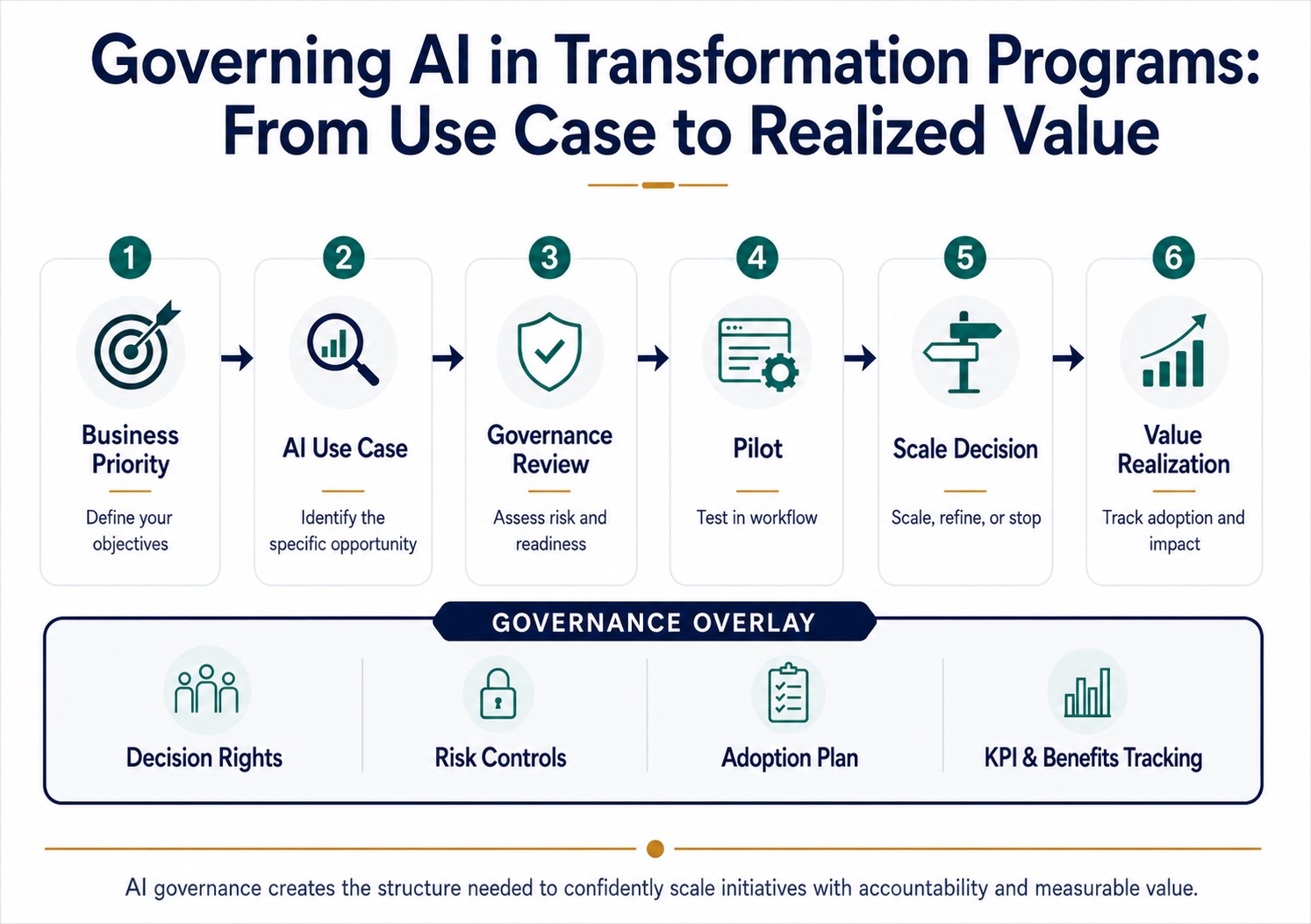
For healthcare executives, AI governance should not be viewed only as a technical control framework. It needs to be a transformation discipline. Successful organizations are establishing clear decision rights, business ownership, value tracking, and risk oversight. Without this structure, AI programs can become a collection of disconnected pilots — interesting, but difficult to measure and scale.
Governance Needs to Match the Pace of AI Adoption
AI initiatives move faster than traditional technology programs. Teams can test tools quickly, users can access capabilities directly, and vendors often bring embedded AI into existing platforms. That speed creates opportunity, but it also increases the need for executive alignment.
Strong governance should answer four essential questions:
- What business problem are we trying to solve?
- Who owns the decision to deploy AI in a workflow?
- How will value, risk and adoption be measured?
- What controls are required before broader use?
The goal is to create a practical structure that allows your organization to confidently move faster.
Practical Tips for AI Transformation Governance
- Establish executive sponsorship tied to your business outcomes.
AI should not sit solely with IT, data science or innovation teams. Every use case should have a business executive sponsor who owns the operational outcome, adoption plan and value case. This keeps the work connected to real performance improvement rather than technology experimentation. - Create a simple intake and prioritization process.
As AI interest grows, your organization should have a clear way of evaluating proposed use cases. The intake process should assess strategic fit, revenue or margin potential, implementation complexity, data readiness, patient/member/customer impact, and risk exposure. You can then focus investment on the initiatives most likely to create measurable value. - Define decision rights before deployment.
AI can affect workflows, staffing models, customer interactions, compliance obligations and decision-making processes. Your governance model needs to clarify who approves pilots, who approves production deployment, who monitors performance and who has authority to pause or modify use. Ambiguity in decision rights can create risk and slow scaling. - Track value realization, not just activity.
Counting pilots, users, or tools does not demonstrate transformation impact. AI governance should include a benefits scorecard tied to business outcomes such as cycle-time reduction, improved productivity, better customer experience, revenue growth, margin expansion, quality improvement or risk reduction. If these benefits cannot be easily measured, the initiative may not be ready to scale.
A Closing Perspective
AI transformation does not succeed through enthusiasm or investment alone. It requires the same disciplines that define any successful enterprise transformation: clear ownership, practical governance, disciplined execution, change management and measurable value realization.
The immediate opportunity is to shift from scattered experimentation to a governed portfolio of AI-enabled transformation initiatives. That does not require a large bureaucracy. It requires a dynamic operating model that helps leaders make better decisions, scale what works and manage risk responsibly.
We see organizations that are getting this right building the leadership, governance and execution muscle to turn AI into a durable source of operational and strategic advantag
How Sunstone Helps
Visit us at www.sunstonemanagementadvisors.com to learn more about how we partner with healthcare payers, providers, and portfolio leadership teams to:
- Architect actionable transformation strategies
- Stand up execution governance and operating systems
- Build leadership alignment and delivery capability
- Ensure financial, operational, and clinical outcomes are realized — and sustained
