




The true test of your transformation program lies in execution: how effectively your organization converts strategic priorities into operational performance, measurable results, and sustainable change.
In healthcare — where clinical realities, financial pressures, and workforce complexity collide — execution discipline can be the differentiator between achieving your transformation vision and abandoning it.
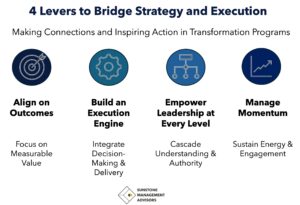
We have identified four foundational levers that healthcare executives can activate to systematically close the strategy–execution gap and accelerate value realization.
- Align on Outcomes — Not Activities
Too many programs measure progress in tasks completed instead of the value that was delivered.
You should define success based on enterprise results, such as:
- Improved patient access and experience
- Workforce productivity and engagement
- Cost efficiency and financial performance
- Quality and clinical outcomes
Strategic ambition becomes practical progress when everyone understands the impact their work must produce — not just the work itself.
- Build an Execution Engine
A plan needs an operating system. While PMOs are often structured for reporting, successfully executing may require a Transformation Office equipped to:
- Integrate decision-making, resourcing, and delivery
- Maintain continuous visibility into risks and bottlenecks
- Enable rapid escalation and proactive course correction
- Govern value realization — not just milestone tracking
This Execution Engine can serve as the “nerve center” that keeps your transformation aligned, accountable, and moving forward.
- Empower Leadership at Every Level
Transformations sometimes fail when momentum is centralized. Success becomes more likely when mid-level and frontline leaders:
- Understand the why behind organizational priorities
- Have authority to make timely decisions
- Communicate consistent messages to their teams
- Model the behaviors required to sustain change
Your strategy can begin to scale when leadership capability becomes scalable.
- Manage Momentum — Not Just Milestones
Dashboards track milestones — you need to steward energy and belief. High-performing organizations:
- Celebrate visible, early wins that can reinforce confidence
- Communicate transparently to reduce resistance
- Adjust pace when “fatigue” begins to set in
- Tell the transformation “story” to make the future-state vivid and relevant
Momentum is the fuel that can carry your teams through the hardest parts of transformation.
 The Bottom Line
Strategy creates direction. Execution creates value. Healthcare organizations that excel at both routinely outperform those that only excel at one. Bridging the gap between them — with clarity, discipline, and empowered leadership — is how transformation becomes more than a plan.
- It becomes a competitive advantage.
- It become a capability
- It delivers the value expected or required
How Sunstone Helps
Visit us at www.sunstonemanagementadvisors.com to learn more about how we partner with healthcare payers, providers, and portfolio leadership teams to:
- Architect actionable transformation strategies
- Stand up execution governance and operating systems
- Build leadership alignment and delivery capability
- Ensure financial, operational, and clinical outcomes are realized — and sustained
